
What's more, part of that VerifiedDumps Analytics-Con-301 dumps now are free: https://drive.google.com/open?id=1jUbcSm7UYb5twhuPTduVNOS-a8nZKFuN
All these three Analytics-Con-301 real dumps formats contain the actual and updated Salesforce Certified Tableau Consultant Analytics-Con-301 exam questions that will surely repeat in the upcoming Analytics-Con-301 exam and you can easily pass it with good scores. Today is the best time to learn new in-demand skills and upgrade your knowledge. Yes, you can do this easily. Just enroll in the Salesforce Certified Tableau Consultant Analytics-Con-301 Exam and start preparation with Salesforce Certified Tableau Consultant Analytics-Con-301 exam dumps. The updated, real, and verified Salesforce Dumps are ready for download. Just pay affordable Salesforce Certified Tableau Consultant Analytics-Con-301 exam dumps charges and get the exam dumps file in your mailbox and start VerifiedDumps Analytics-Con-301 exam preparation.
| Topic | Details |
|---|---|
| Topic 1 |
|
| Topic 2 |
|
| Topic 3 |
|
| Topic 4 |
|
| Topic 5 |
|
>> Updated Analytics-Con-301 Demo <<
As you may see the data on the website, our sales volumes of our Analytics-Con-301 exam questions are the highest in the market. You can browse our official websites to check our sales volumes. At the same time, many people pass the exam for the first time under the guidance of our Analytics-Con-301 Practice Exam. And there is no exaggeration that our pass rate for our Analytics-Con-301 study guide is 98% to 100% which is proved and tested by our loyal customers.
NEW QUESTION # 71
A client wants to use a bar chart to visualize the trend in profit per quarter for the last 5 years. They want each bar's color to be determined by whether the profit during that quarter was greater than the median profit for the past four quarters, including the current quarter.
For example, if a bar represents profit for 2020 Q4, they want to visually see whether the profit for 2020 Q4 is greater than the median profit for 2020 Q1-2020 Q4.
Which table calculation should produce the desired result?
Answer: C
Explanation:
Comprehensive and Detailed Explanation From Exact Extract:
The requirement is to compare each quarter's profit to the median profit over a rolling window of the last four quarters, including the current one. This is a classic use case for WINDOW_ table calculations in Tableau.
Tableau documentation explains:
* WINDOW_MEDIAN( expression, start, end ) computes the median of the expression over a window of rows defined by start and end, which are offsets relative to the current row.
* To create a rolling calculation that includes the current row and the three preceding rows, the window frame must span four rows ending at the current row.
Conceptually, the correct pattern is:
* Current quarter's profit: SUM([Profit])
* Rolling four-quarter median: WINDOW_MEDIAN(SUM([Profit]), previous_3, current) In actual Tableau syntax, that pattern is written with a frame that begins three rows before the current row and ends at the current row.
Among the options provided:
* Options A and B use INDEX() or FIRST() as the start of the window, which creates frames anchored to either the first row or varying positions in the partition, not a consistent four-quarter trailing window.
* Option D anchors the frame relative to LAST(), which makes the window depend on the final row in the partition, not a trailing four-quarter window for each bar.
Option C uses a fixed frame of four rows expressed as (3, 0) in the argument list. While, in exact Tableau syntax, a trailing 4-row frame is typically written with a negative start offset and zero as the end offset, this option is clearly intended to represent the frame "three rows back through the current row" and is therefore the only answer that matches the required rolling four-quarter window conceptually.
So, using a WINDOW_MEDIAN over a four-row frame ending at the current row, as shown in option C, is the intended solution for coloring each bar based on whether:
SUM([Profit]) > rolling_median_over_last_4_quarters
* Tableau table calculation reference describing WINDOW_ functions and their start/end frame parameters.
* Examples in Tableau help that use WINDOW_SUM or WINDOW_AVG with a frame spanning a fixed number of previous rows to compute rolling-window metrics.
* Best practices for using WINDOW_MEDIAN to compute rolling medians over sliding time windows.
NEW QUESTION # 72
A client has a sales dataset that contains fields named Customer ID, Region, Item, and Sales Amount. Each row represents a single sale. There may be multiple sales for each Customer ID.
The client wants to visualize the average total customer sales by region.
Which Level of Detail (LOD) expression should a consultant recommend?
Answer: A
Explanation:
Comprehensive and Detailed Explanation From Exact Extract:
The requirement is:
* Compute total sales per customer, not per transaction.
* Then compute the average of those customer totals, grouped by region.
Tableau documentation states that FIXED LOD expressions are used to calculate values at a specific level of granularity regardless of the view.
To solve the business need:
Step 1:
Calculate total customer sales for each Customer ID within each Region:
{ FIXED [Customer ID], [Region] : SUM([Sales Amount]) }
This produces one number per customer per region.
Step 2:
Compute the average of those totals:
AVG( { FIXED [Customer ID], [Region] : SUM([Sales Amount]) } )
This yields:
Average total customer sales by region
This is exactly option C.
Why the other options are incorrect:
* A. EXCLUDE Region: Would combine regions and incorrectly calculate overall totals.
* B. FIXED Region: AVG(Sales Amount): Computes average of line-level sales, not customer totals.
* D. FIXED Customer ID + Region: AVG(Sales Amount): Averages individual transactions, not customer totals.
Only option C matches the required two-step logic.
* LOD Expressions: FIXED for computing customer-level aggregates.
* Nested LOD usage for first calculating customer totals, then averaging them at a higher level.
* Tableau guidance: SUM inside FIXED for per-customer totals, AVG outside for averaging customers.
NEW QUESTION # 73
A client collects information about a web browser customers use to access their website. They then visualize the breakdown of web traffic by browser version.
The data is stored in the format shown below in the related table, with a NULL BrowserID stored in the Site Visitor Table if an unknown browser version accesses their website.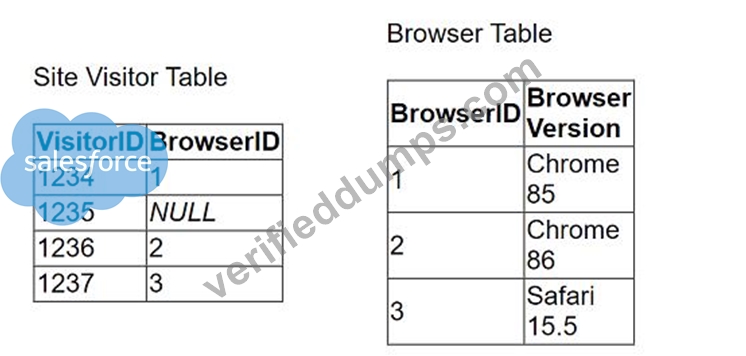
The client uses "Some Records Match" for the Referential Integrity setting because a match is not guaranteed. The client wants to improve the performance of the dashboard while also getting an accurate count of site visitors.
Which modifications to the data tables and join should the consultant recommend?
Answer: A
Explanation:
To improve the performance of a Tableau dashboard while maintaining accurate counts, particularly when dealing with unknown or NULL BrowserIDs in the data tables, the following steps are recommended:
Modify the Browser Table: Add a new row to the Browser Table labeled "Unknown," assigning it a unique BrowserID, e.g., 0 or 4.
Update the Site Visitor Table: Replace all NULL BrowserID entries with the BrowserID assigned to the "Unknown" entry. This ensures every record in the Site Visitor Table has a valid BrowserID that corresponds to an entry in the Browser Table.
Change Referential Integrity Setting: Change the Referential Integrity setting from "Some Records Match" to "All Records Match." This change assumes all records in the primary table have corresponding records in the secondary table, which improves query performance by allowing Tableau to make optimizations based on this assumption.
References:
Handling NULL Values: Replacing NULL values with a valid unknown option ensures that all data is included in the analysis, and integrity between tables is maintained, thereby optimizing the performance and accuracy of the dashboard.
NEW QUESTION # 74
A client is searching for ways to curate and document data in order to obtain data lineage. The client has a data source connected to a data lake.
Which tool should the consultant recommend to meet the client's requirements?
Answer: B
Explanation:
To effectively curate and document data for obtaining data lineage, particularly from a data source connected to a data lake, the recommended tool is:
Tableau Catalog with Tableau Data Management Add-on: This add-on enhances the capabilities of Tableau Catalog, providing extensive features for data management, including detailed data lineage, impact analysis, and metadata management.
Functionality: The Tableau Catalog with the Data Management Add-on allows users to see the full history and lineage of the data, trace its usage across all Tableau content, and understand dependencies. It also facilitates better governance and transparency in data handling.
Why Choose this Tool: For a client needing comprehensive data lineage and documentation capabilities, this add-on ensures that data stewards and users can maintain and utilize a well-managed data environment. It supports robust data governance practices necessary for large and complex data ecosystems like those typically associated with data lakes.
References
The recommendation is based on the functionalities offered by the Tableau Data Management Add-on, as described in Tableau's official documentation on managing and documenting data sources for enhanced governance and operational efficiency.
NEW QUESTION # 75
SIMULATION
From the desktop, open the CC workbook.
Open the Incremental worksheet.
You need to add a line to the chart that
shows the cumulative percentage of sales
contributed by each product to the
incremental sales.
From the File menu in Tableau Desktop, click
Save.
Answer:
Explanation:
See the complete Steps below in Explanation
Explanation:
To add a line showing the cumulative percentage of sales contributed by each product to the incremental sales in the Incremental worksheet of your Tableau Desktop, follow these detailed steps:
Open the CC Workbook and Access the Worksheet:
From the desktop, double-click on the CC workbook to open it in Tableau Desktop.
Navigate to the Incremental worksheet by clicking on its tab at the bottom of the window.
Calculate Cumulative Sales Percentage:
Create a new calculated field to compute the cumulative percentage of sales. Right-click in the Data pane and select 'Create Calculated Field'.
Name this field "Cumulative Sales Percentage".
Enter the following formula to calculate the running sum of sales as a percentage of the total sales:
(RUNNING_SUM(SUM([Sales])) / TOTAL(SUM([Sales])) [Sales]))
Click 'OK' to save the calculated field.
Add the Cumulative Sales Percentage Line to the Chart:
Drag the "Cumulative Sales Percentage" field to the Rows shelf, placing it next to the existing Sales measure.
Ensure that the cumulative line appears as a continuous line. Right-click on the "Cumulative Sales Percentage" field on the Rows shelf, select 'Change Chart Type', and choose 'Line'.
Adjust the axis to synchronize or dual-axis if necessary. Right-click on the axis of the "Cumulative Sales Percentage" and select 'Synchronize Axis' if it's on a dual-axis setup.
Format the Cumulative Sales Percentage Line:
Click on the "Cumulative Sales Percentage" line in the visualization.
Navigate to the 'Format' pane to adjust the line style, thickness, and color to make it distinct from other data in the chart.
Save Your Changes:
From the File menu, click 'Save' to ensure all your changes are stored.
References:
Tableau Help: Provides additional details on creating calculated fields and customizing line charts.
Tableau User Guide: Offers extensive instructions on formatting charts, including line types and axis synchronization.
By following these steps, you will successfully add a cumulative sales percentage line to your chart, enhancing the visualization to reflect the incremental contribution of each product to the overall sales in a dynamic and informative manner.
NEW QUESTION # 76
......
There are a lot of the functions on our Analytics-Con-301 exam questions to help our candidates to reach the best condition befor they take part in the real exam. I love the statistics report function and the timing function most. The statistics report function helps the learners find the weak links and improve them accordingly. The timing function of our Analytics-Con-301 training quiz helps the learners to adjust their speed to answer the questions and keep alert and our Analytics-Con-301 study materials have set the timer.
Test Analytics-Con-301 Centres: https://www.verifieddumps.com/Analytics-Con-301-valid-exam-braindumps.html
2026 Latest VerifiedDumps Analytics-Con-301 PDF Dumps and Analytics-Con-301 Exam Engine Free Share: https://drive.google.com/open?id=1jUbcSm7UYb5twhuPTduVNOS-a8nZKFuN